
What is a clinical trial?
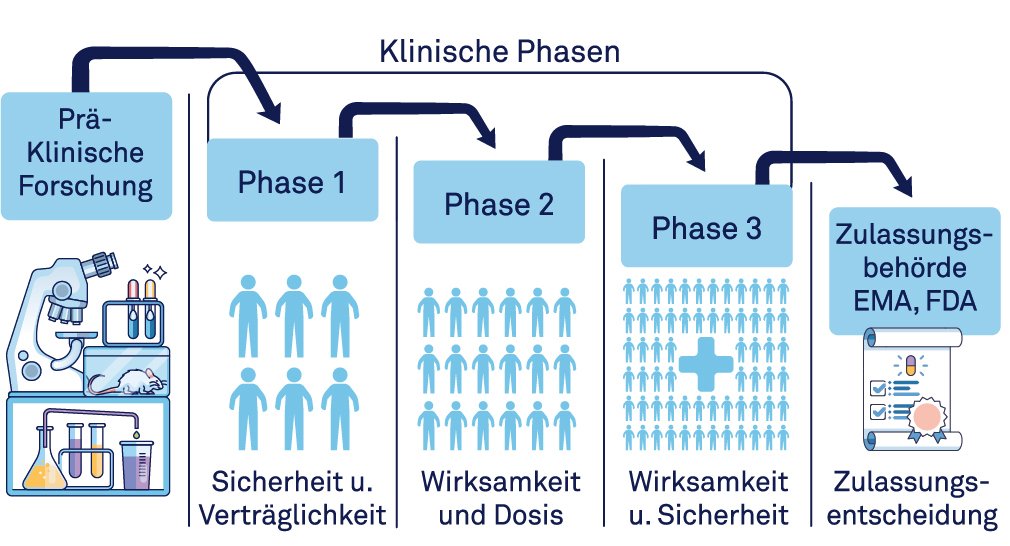
Clinical trials are scientific, carefully planned studies designed to
- systematically evaluate new medical treatments,
- medicines,
- active substances or
- diagnostic procedures.
The aim is to investigate their efficacy, safety and potential side effects under controlled conditions. Clinical trials adhere to strict ethical and legal guidelines to ensure the protection of participants.
They are usually divided into several phases: from initial tolerability tests to large-scale studies designed to show whether a new therapy is better than or equivalent to existing methods. For patients, clinical trials offer the opportunity to gain early access to innovative treatments, whilst at the same time making an important contribution to medical progress.
Clincial phases
Phase 1: In this phase, the safety and tolerability profile of a drug is assessed, a suitable dose is determined, and the way in which the drug is distributed throughout the body and excreted is investigated (pharmacokinetics).
Phase 2: This phase tests whether the drug is effective in a (larger) group of patients with a specific condition and determines the appropriate dose.
Phase 3: This phase tests the efficacy and safety, typically in several hundred to several thousand patients, usually in comparison with available treatments, and ideally leads to the drug’s approval.
Participate in one of our studies
Are you interested in participating in a clinical trial ?
You can access the registration form here and register without any obligations. In case there is a trial that is suitable for you, we will contact and inform you. Often we are looking for healthy volunteers who can also register here.
Alternatively, you can view our trials that are currently recruiting participants here.